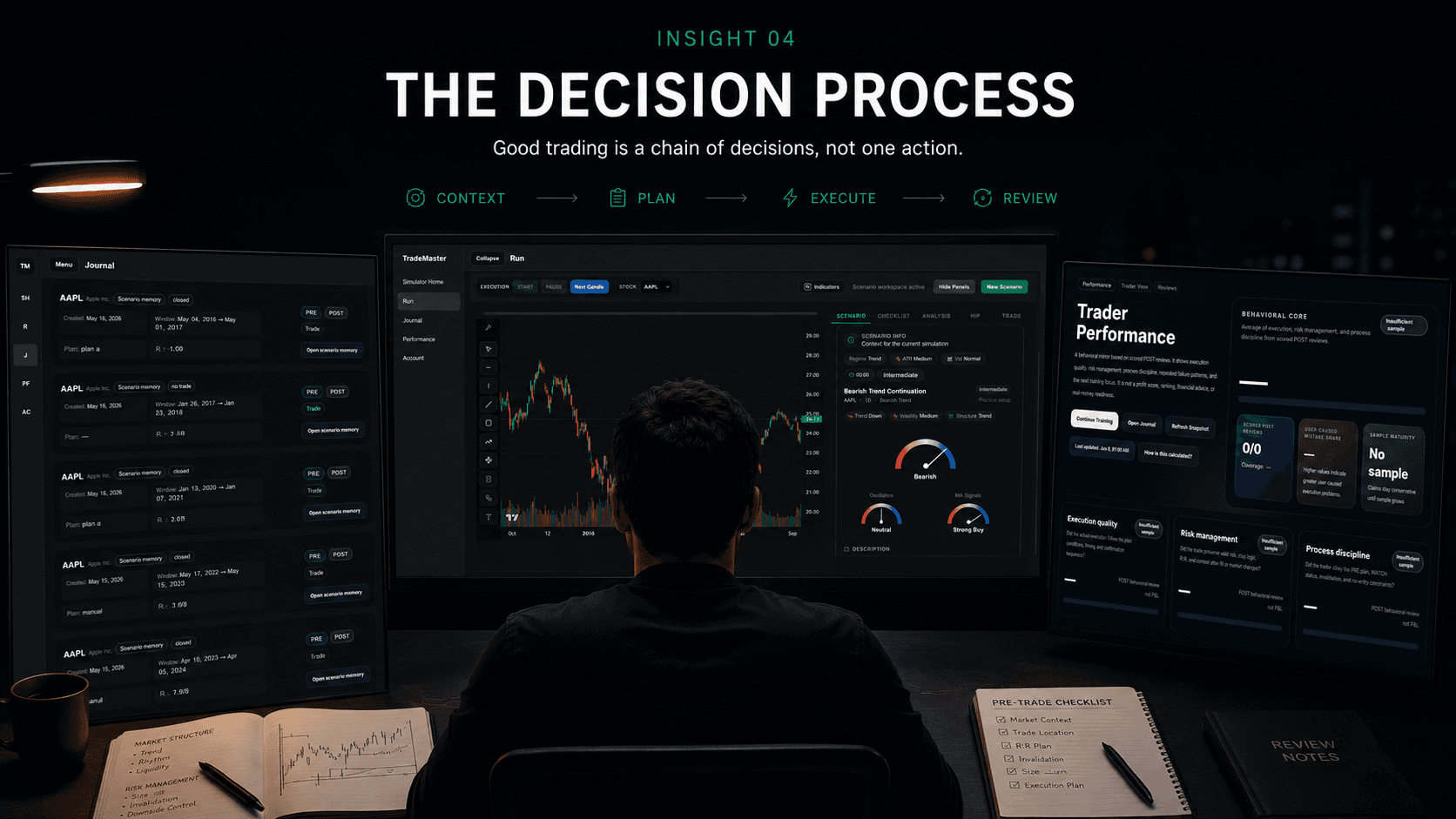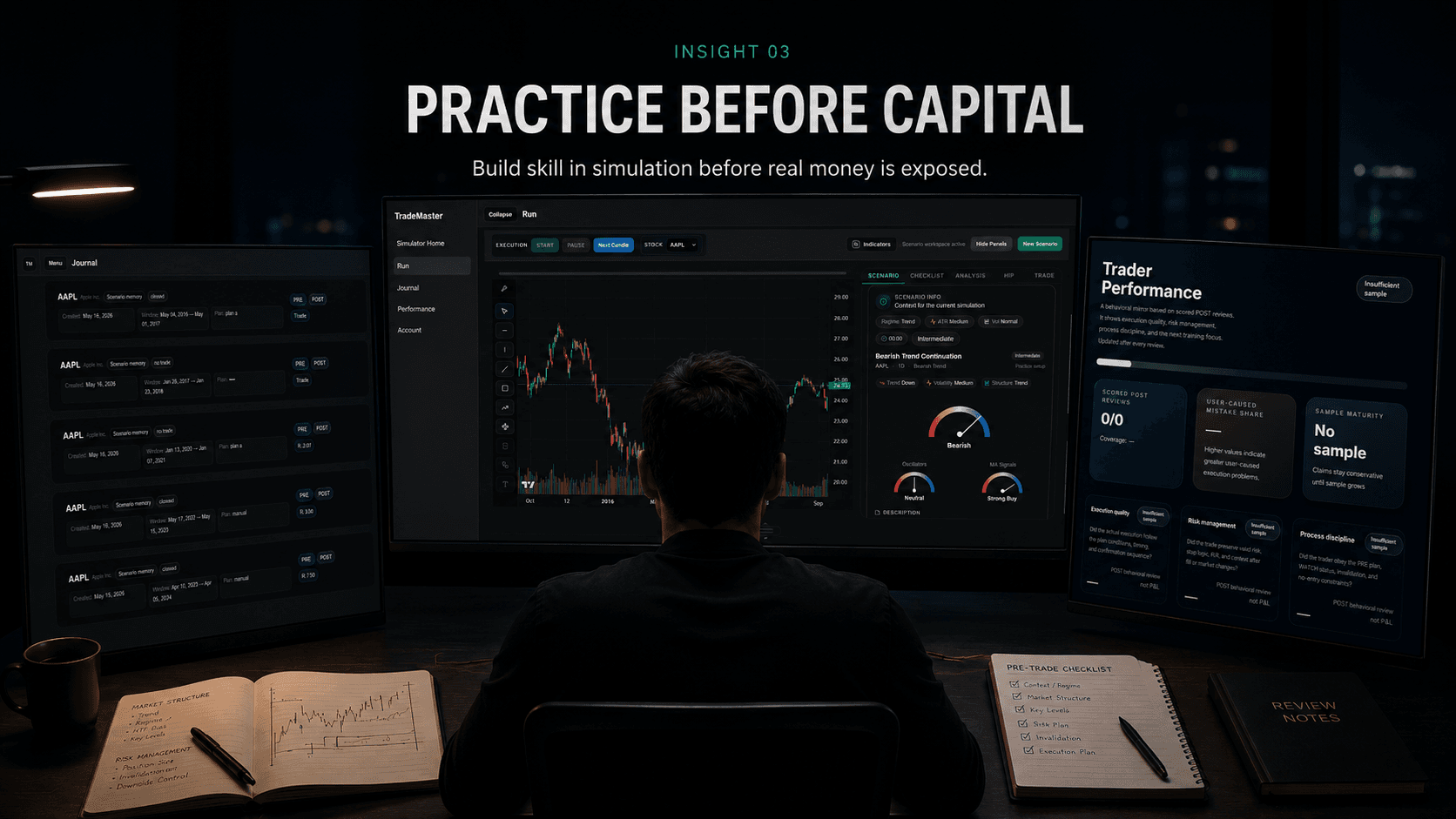
There is a big difference between understanding a concept and being ready to act on it. A beginner can watch lessons, read charts, learn terminology, and still feel unprepared when a decision has to be made. That gap is not strange. It is what happens when theory moves faster than experience. Simulation exists to slow that jump down.
The value of a simulator is not that it removes uncertainty. It does not. The value is that it gives the user a place to repeat the process without turning every mistake into a real-market event. A structured scenario can ask the user to prepare, act inside a simulated workflow, review the decision, and return to the evidence later. That is very different from only reading another explanation.
TradeMasterSim is built around that type of repetition. The product is not trying to be a prediction tool, a signal service, or a broker. It is trying to give users a training surface where the decision process becomes visible: what the user saw, what they planned, how they acted, what they wrote afterward, and what the replay can show later.
This matters because the small details are usually where beginners struggle. Did the user act before the plan was clear? Did they ignore the checklist? Did they explain the decision differently after the result? Did the same behavior appear again in another scenario? Those questions are hard to answer from theory alone, because theory usually shows the clean version of the idea. Practice shows the messy version of the user.
A simulator also creates a better place for feedback. If review is connected to the original scenario, the user is not only looking at an outcome. They are looking at the process that led there. That is why TradeMasterSim connects scenario context, simulated execution, POST review, journal memory, replay, and performance-intelligence surfaces. The goal is educational review, not market instruction.
The best part of simulation is that it gives the user another rep. One scenario is not enough to understand a habit. Repetition helps users notice whether the same preparation mistake, rushed action, or weak review keeps appearing. That is where practice becomes more useful than theory alone, because the user is no longer only studying the idea. They are seeing their own process under pressure.
Simulation still has limits. It cannot turn practice into certainty, and it cannot promise real-market outcomes. Users still need independent judgment before any real-world decision. For the execution gap, read strategy is not execution. For the beginner problem, read why beginner traders struggle. For the product direction, visit About TradeMasterSim.