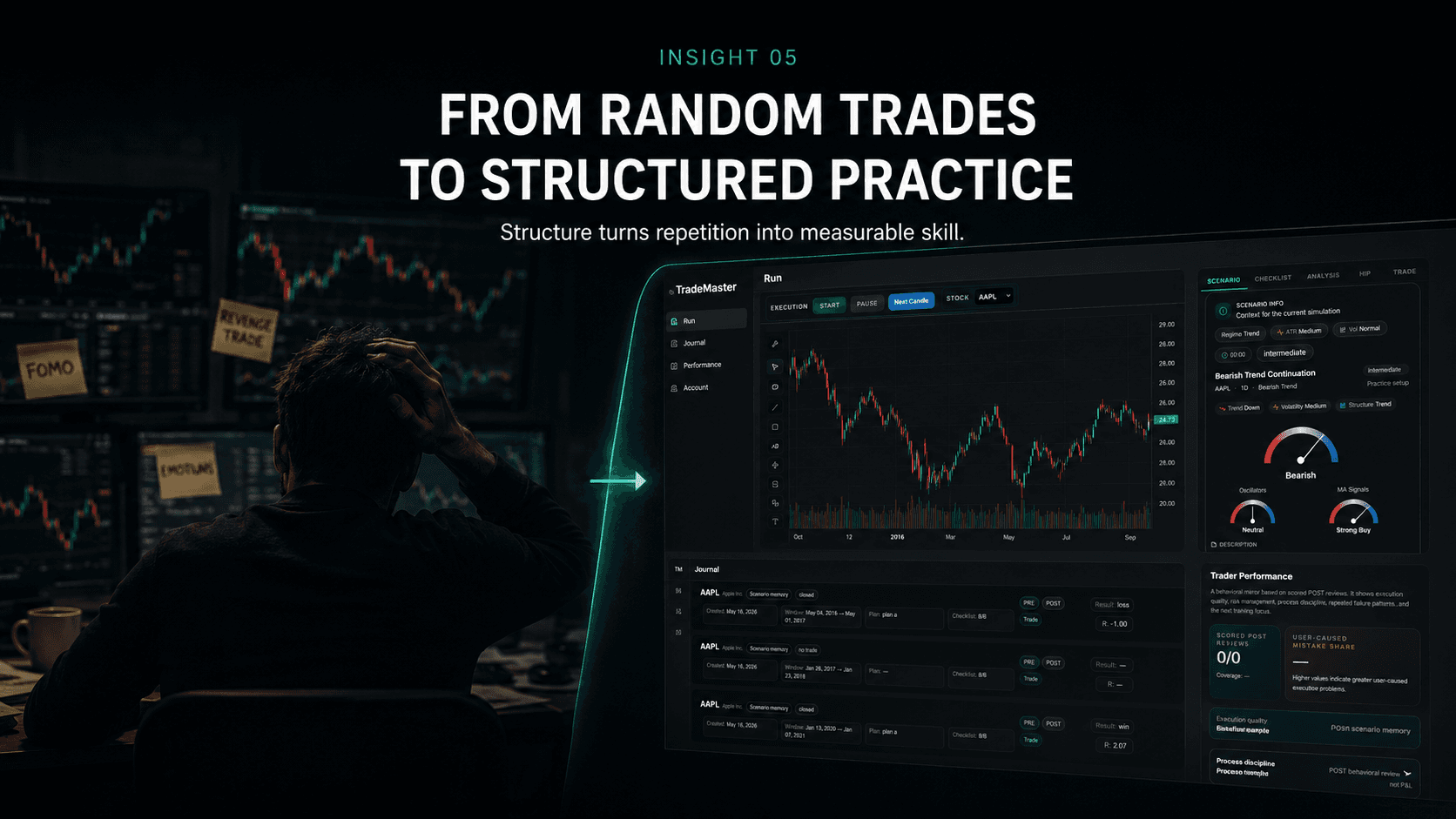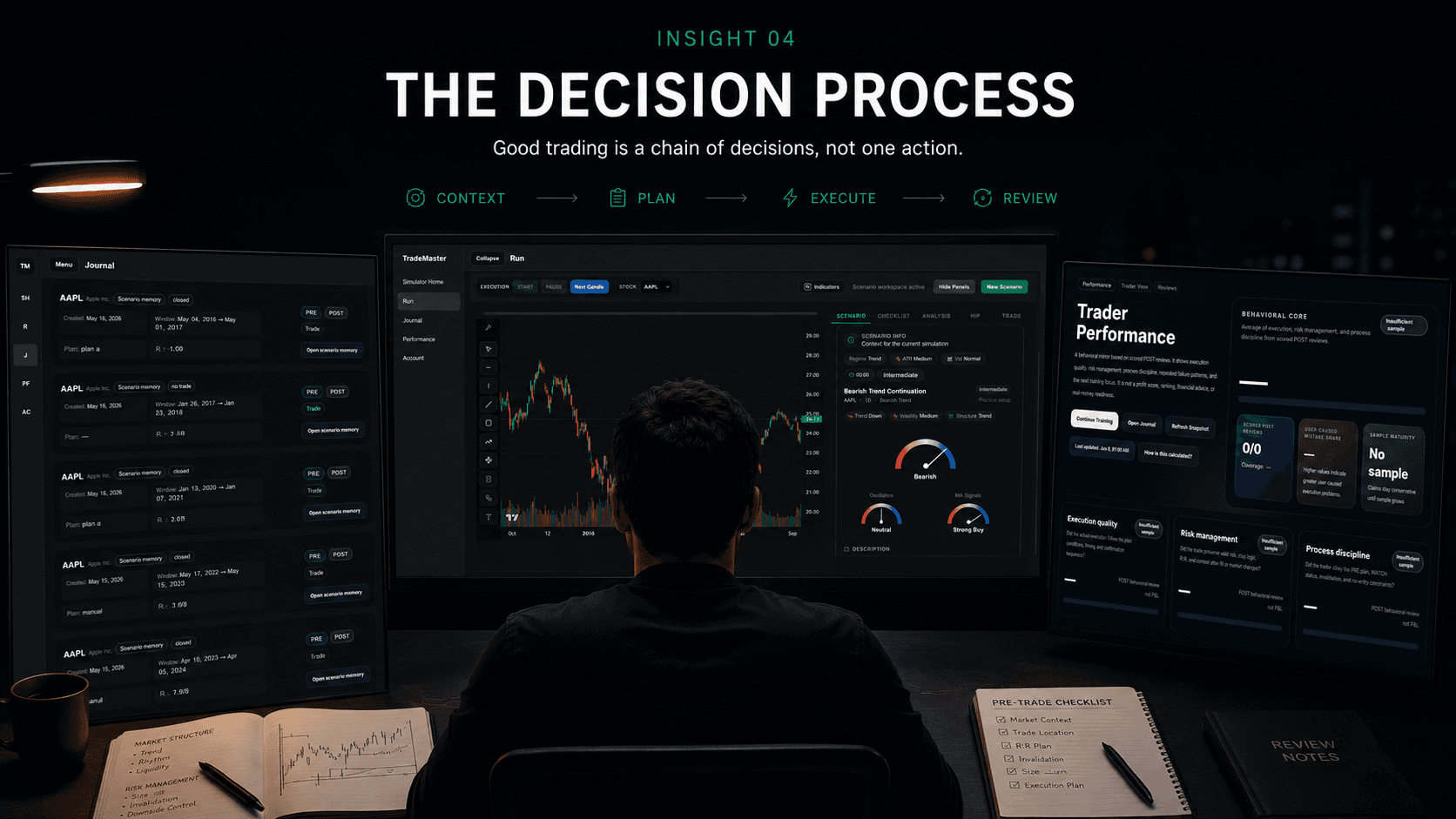
One of the most expensive misunderstandings for a beginner is thinking that a strategy and execution are the same thing. They are not. A strategy is the idea: the setup, the condition, the pattern, the rule, the reason a trade might be considered. Execution is what happens when the user has to apply that idea in real time, with pressure, hesitation, uncertainty, and incomplete information.
This is where many people discover that knowing a setup does not mean they can follow a process. They may enter too early, wait too long, change the plan after seeing the result, skip the checklist, or forget why the decision was made. The chart can look simple afterward, but the moment of action rarely feels that clean while it is happening.
TradeMasterSim is built around that gap. The product does not try to validate a strategy, provide signals, or tell users what to trade. It gives users a structured place to practice the workflow around the decision: scenario context, preparation, simulated execution, POST review, journal memory, replay, and performance-intelligence surfaces. The focus is not the market call. The focus is the process around the simulated decision.
That distinction matters because the same strategy can produce very different learning outcomes depending on how it is executed. A user who documents the plan before action learns something different from a user who explains the decision only after the result. A user who reviews repeated behavior across scenarios learns something different from a user who only remembers the last outcome. Execution is where the hidden habits become visible.
This is also why a simulator should not be confused with a prediction tool. A serious practice environment should not pretend to know what the market will do next. It should help users see whether they acted with structure, whether the decision matched the plan, and whether the review captured the right lesson. That is a training problem, not a forecasting promise.
The practical value is in repetition. One isolated scenario may show a mistake. Several scenarios can start to show a pattern. A user may notice that the same type of hesitation, rushed action, unclear plan, or weak review appears again and again. That is where execution training becomes more useful than another theory explanation.
For the broader practice model, read simulation before real capital. For why isolated notes can miss the full context, read why journaling alone is not enough. For the product workflow, open How TradeMasterSim works.